 The Largest Number of Homes for Sale
Condominiums in Quebec: key trends and new realities
Condominiums are playing an increasingly important role in the Quebec real estate market. More affordable than single-family homes and well suited to evolving urban lifestyles, they now account for nearly one in four residential transactions.
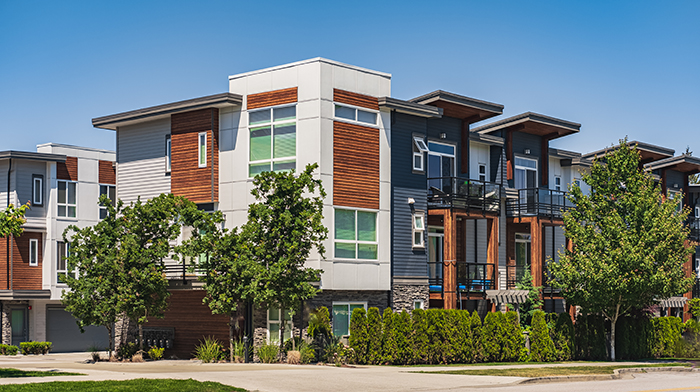
A growing place for condominiums in the Quebec real estate market
Over the years, condominiums have become an essential component of the Quebec real estate landscape. Once seen as a niche option, they are now at the centre of housing choices for many households across the province, particularly in major urban centres.
As highlighted by the Quebec Professional Association of Real Estate Brokers in its study Condominiums: A Balance Between Compromise, Legislation, and Financial Pressures, based on Centris data, condos are taking up an increasingly significant share of real estate transactions.
In the episode The Evolution of Condominiums from the podcast L’immobilier en mouvement, economist Camille Laberge also notes:
“Condominiums have expanded significantly over the past 20 years. Ten years ago, it was one in five transactions. Today, it’s one in four.”
This shift reflects changes in lifestyles, as well as the market’s adaptation to current economic realities. Several factors explain this growth:
- Urban densification
- Smaller household sizes
- Relative affordability
As Camille Laberge summarizes:
“Condominiums have become a product available across Quebec and accessible to a large number of households.”
A reality that takes many forms
Before going further, it is essential to understand what a condominium actually is.
“Legally, it is a building divided into private and common areas. Each owner holds their unit, but also a share of the common spaces,” explains Camille Laberge.
Contrary to popular belief, condominiums are not limited to downtown high-rise buildings. They can also take the form of:
- Townhouses
- Divided duplexes
- Small multi-unit buildings
This diversity contributes to their growing accessibility and popularity.
Condos: a two-speed market
The condominium market does not evolve uniformly across Quebec.
According to recent data:
- Montreal and Gatineau: more balanced markets, generally more favourable to buyers
- Quebec City, Saguenay, Trois-Rivières: still highly competitive markets
As Camille Laberge summarizes:
“Markets do not evolve at the same pace. In the west, we are seeing a slowdown, while in eastern markets demand remains strong and prices are still under pressure.”
Real estate cycles across Quebec are not perfectly synchronized. Strong growth began earlier in western markets, while eastern regions experienced it later. As a result, the condominium market varies significantly from one region to another.
Rising prices… but more cautious demand
Over the past decade, condominium prices have increased significantly. However, growth has been gradually slowing.
This trend is partly explained by buyers’ financial capacity.
“Demand is still there, but it is becoming more cautious,” the study notes.
Still, condominiums maintain a key advantage:
“They remain more affordable than single-family homes, even when monthly fees are included, even when compared with entry-level detached houses,” says Camille Laberge.
Bill 16: a major turning point for condominiums
The implementation of Bill 16 has significantly transformed condominium management.
New requirements include:
- Mandatory maintenance logbook
- Reserve fund study every five years
- Increased transparency
“The goal is simple: to ensure better long-term financial planning,” explains Camille Laberge.
However, this reform has also led to important adjustments in some cases.
A market in transformation… and increasingly strategic decision-making
The Quebec condominium market is not declining; it is evolving.
Condominiums are a clear example of this shift:
- more regulated
- more transparent
- but also more demanding
“Budgets often push buyers to make more rational decisions,” summarizes Camille Laberge.
Rising condominium fees… but not out of step with reality
One of the most visible impacts of Bill 16 is the increase in condominium fees.
“Yes, fees have increased significantly, but they are evolving at the same pace as property values,” explains Camille Laberge.
Over a 10-year period:
- Fees have nearly doubled
- But they still represent about 0.9% of the property’s value
In other words, they remain proportional to the value of the units and reflect a more realistic approach to future expenses.
Affordability: a reality that needs nuance
Condominiums remain an entry point into homeownership, but their affordability must be assessed more broadly. The sharp increase in condo fees can discourage some buyers at first glance.
A point often overlooked, according to Camille Laberge:
“In a house, we often forget to account for maintenance costs, which should represent, on average, between 1% and 3% of the property’s value per year.”
In this sense, condo fees replace expenses that are partly invisible for single-family homeowners.
Special assessments: a real risk, but declining
Special assessments remain an important issue.
In 2025, about 5% of transactions involved one.“It is often the result of an insufficient reserve fund,” explains Camille Laberge.
The good news:
“In the long term, Bill 16 should significantly reduce these situations.”
A key solution in the affordability crisis
Beyond the market itself, condominiums play a strategic role in housing policy.
In the podcast, Simon Langelier notes:
“Condominiums are a very affordable product, but this reality is not always reflected in public policy.”
He adds:
“If we want to improve access to homeownership, we should rely more on condominiums in government programs.”
This could include:
- Targeted tax incentives
- Specific assistance programs
- Adaptation of housing policies
A lifestyle aligned with current trends
Beyond financial considerations, condominiums also offer concrete advantages:
- Proximity to services
- Access to public transit
- Urban lifestyle
- Simplified maintenance
“Condominiums are often located near transit networks and services, which reduces dependence on cars,” recalls Simon Langelier.
And contrary to stereotypes:
“It’s no longer just downtown condos for young professionals. The offer has become much more diverse.”
Why working with a real estate broker is essential
In this increasingly complex context, the role of a real estate broker is crucial.
Buying a condominium requires understanding:
- Financial statements
- The reserve fund
- Meeting minutes
- Bylaws and regulations
A broker helps:
- Identify risks
- Interpret documents
- Secure the transaction
Key takeaways
- Condominiums now account for about 25% of transactions
- They are more affordable than single-family homes
- Conditions vary significantly by region
- Fees are increasing, but reflect better management
- Bill 16 improves transparency
- Special assessments should decline over the long term
In a context where access to homeownership remains a challenge for many households, condominiums continue to be a key solution. However, like any real estate project, they require a thorough analysis. When considering a condominium, it is important to take into account the syndicate’s financial health, the building’s condition, and its associated obligations. With proper information and support from qualified professionals, buyers can make informed decisions and fully benefit from this evolving form of housing.
Article written in collaboration with:


See also:
The complete 12-step guide to selling your home