The Largest Number of Homes for Sale
Dry rot: from early signs to solutions
Strange marks on a beam, crumbling wood, a constantly damp area in the basement… These are all signs that warrant a closer look. While mould is well known to homeowners, dry rot is much less so. Yet this wood-destroying fungus is among the most destructive to structural wood. Its presence may be discovered during renovation work or raise concerns when considering the purchase of a home, especially if the seller has disclosed its presence.
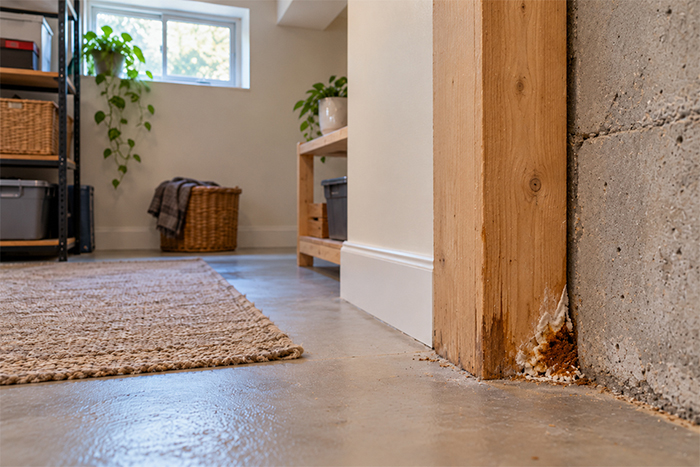
Should you worry at the slightest sign of something unusual? Not necessarily. The key is knowing how to recognize the warning signs. From early indicators to practical solutions, learn how to identify dry rot, understand the conditions that promote its growth, assess the risks, and protect your property.

|
At a glance
|
What is dry rot?
Behind its rather unusual name lies a wood-decaying fungus—that is, an organism that feeds on the components of wood. Known scientifically as Serpula lacrymans, dry rot causes the gradual degradation of wood by attacking its cellulose in particular.
It is responsible for what is known as cubic rot: the wood turns brown, cracks into small blocks, and becomes brittle. It is also referred to as “weeping dry rot fungus,” a term that can be misleading since moisture is essential for its development.
Its presence in Quebec is not new. A scientific review published in Phytoprotection and indexed by Natural Resources Canada indicates that specimens of the weeping dry rot fungus were collected there as early as 1947.
Under what conditions does it develop?
It often starts with a water problem that goes unnoticed or takes too long to fix. Water damage that hasn’t been properly dried out, a water infiltration or a persistent leak can therefore create conditions conducive to its growth. As the Institut national de santé publique du Québec (INSPQ) points out, the presence of damp materials is essential for the growth of this fungus.
Dark, poorly ventilated areas where moisture tends to accumulate deserve special attention. This is particularly true of basements and crawl spaces, as well as areas hidden behind walls or under floors. When wood remains damp for an extended period, the fungus can take hold and continue to degrade it out of sight.
Poor waterproofing, repeated water infiltration, or insufficient ventilation can all contribute to the problem. That’s why it’s important not to ignore signs of moisture in a home, even when they seem minor. A stain on the ceiling or a lingering odour in the basement doesn’t necessarily mean dry rot is present, but it may indicate a moisture problem that should be investigated.
How can you identify dry rot?
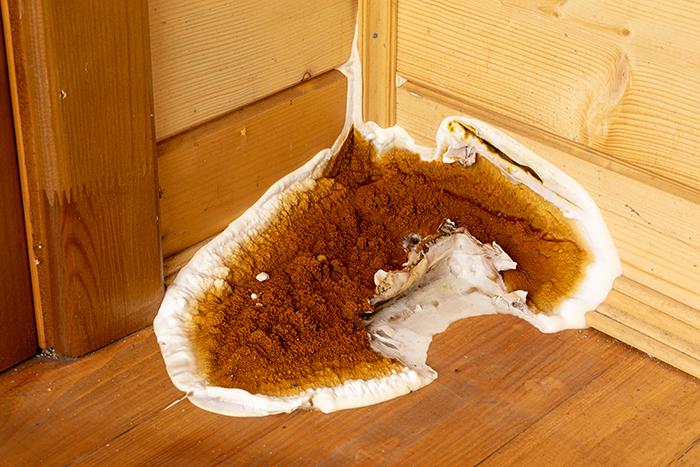
Dry rot can take on different appearances depending on its stage of development.
What should you look for in your home?
The report État de la situation sur la mérule pleureuse au Québec, published by the Société d’habitation du Québec, describes several characteristic signs of this fungus.
|
|
|
|
Signs |
Details |
|
White, cottony material |
A layer resembling cotton wool or a spiderweb |
|
Greyish filaments or strands |
Branches that spread across the wood or adjacent surfaces |
|
Orange or brownish growth |
A flattened mass, sometimes bordered by a paler area |
|
Brownish dust |
A deposit of spores on surrounding surfaces |
|
Darkened, brittle, or crumbly wood |
Material that crumbles or becomes brittle |
|
Cubical cracks |
Wood that splits into blocks characteristic of cubic rot |
Be careful not to jump to conclusions! These symptoms are not unique to dry rot. Other fungi may look similar. To confirm that it is indeed dry rot, a sample can be submitted for specialized analysis, such as microscopic examination or genetic testing (PCR).
Another distinctive feature: this fungus can spread far beyond what is visible. The Régie du bâtiment du Québec (RBQ) explains that it can travel through certain porous materials, mortar joints, or cracks to reach other wooden components. A small affected area therefore does not necessarily reflect the full extent of the problem.
What should you do before buying a house?
Have you found a house you like, but signs of moisture have caught your attention? Find out about past water leaks and any repairs made to address them. The seller is required to disclose any known problems that could affect the property.
A pre-purchase inspection may reveal signs of moisture or wood deterioration. However, it has its limitations: the inspector primarily examines visible and accessible areas. If suspicious signs are found, a more thorough investigation by a specialized professional may be necessary.
What if dry rot is discovered after the purchase? Depending on the circumstances, its presence could constitute a hidden defect and give rise to a claim. It all depends on the severity of the problem, whether it was hidden, and the terms of the sale.
What kind of damage can dry rot cause to a house?
A wooden component may appear relatively intact even though it has lost some of its strength. This is one of the concerning aspects of the damage caused by dry rot. The severity of the damage is not always proportional to what can be seen with the naked eye.
A scientific study published in 2025 in the Journal of Building Physics shows that the loss of mechanical strength in infested wood cannot be reliably assessed by a simple visual inspection.
This deterioration can have significant consequences when load-bearing elements—such as beams or joists—are affected. Other contaminated wooden components may seem less critical, but they nonetheless contain microscopic spores that can settle on other surfaces and contribute to the spread of the fungus.
The Government of Quebec confirms that damage caused by dry rot can lead to structural failures and require complex restoration work.
Beyond the building’s structural integrity, the necessary repairs can entail significant expenses and affect its value. The condition of the property and the work to be done are among the factors that can lower a home’s value.
Is dry rot dangerous to human health?
Dry rot can wreak havoc on a home, but does it also pose a danger to its occupants? The scientific evidence on this matter is reassuring.
According to the INSPQ, dry rot is not considered pathogenic, infectious, or toxic to humans. The main documented risks therefore concern the building itself, rather than the fungus’s direct effects on health.
There is, however, an important caveat. Conditions favourable to dry rot can also encourage the growth of other moulds, particularly those of the genera Penicillium and Aspergillus. The presence of these moulds in indoor air can lead to indoor air quality problems and respiratory infections, among other issues.
In short, while dry rot is not recognized as a direct health hazard, it can nevertheless indicate a moisture problem whose consequences extend beyond mere structural deterioration.
What should you do if you suspect you have dry rot?
Do you think you’ve found dry rot in your home? Before you break out the tools, it’s best to know what you’re dealing with! The first step is to have the fungus identified and determine the extent of the problem. A well-planned response can prevent unnecessary or inappropriate work.
Who should you contact, and where should you start?
The good news is that the Quebec government confirms that it is possible to decontaminate a building affected by dry rot and restore it to good condition. The process consists of two main phases: investigation and decontamination work.
To confirm the presence of the fungus and determine the necessary actions, consult a building expert specializing in fungal contamination, who may, among other things, request a laboratory analysis of suspicious materials.
To provide a framework for these interventions, the Bureau de normalisation du Québec has developed standard BNQ 3009-610, which establishes the requirements for the investigation and rehabilitation of buildings contaminated by dry rot.
Before hiring a company, make sure it has the necessary expertise as well as the required licences and insurance. Also, avoid removing materials showing signs of contamination yourself before obtaining professional advice.
 |
Tips and tricks
According to the INSPQ, the moisture content of wood must remain below 19%. A wood moisture meter allows you to take a few readings and send the results to a specialist. However, it is not a substitute for a professional assessment. |
How can you prevent dry rot from developing?
The best strategy against dry rot? Don’t let it have the conditions it needs to take hold! A few good maintenance habits can help protect your home in the long run.
- Respond quickly to water damage. After a leak or water intrusion, dry out the affected materials and make sure moisture doesn’t linger in hard-to-reach areas.
- Keep an eye on less-frequented areas. Periodically inspect the basement and crawl space, especially after heavy rains or snowmelt.
- Ensure proper air circulation. Use appropriate ventilation systems and address recurring condensation issues.
- Maintain the building envelope. Monitor the condition of the roof, gutters, foundation, and weatherstripping. A well-maintained French drain also helps keep water away from the foundation.
|
Tips and tricks
A hygrometer helps you monitor the humidity level in your home. According to Health Canada, aim for a level below 50% in the summer and around 30 to 35% in the winter. If humidity remains high, investigate the cause. |
Protect your home with regular maintenance
Dry rot serves as a reminder of just how much water can become a home’s enemy when it seeps into places it shouldn’t. Fortunately, many moisture-related problems can be prevented through regular maintenance and timely repairs.
To stay one step ahead of small problems that could escalate, check out our guides to spring and fall home maintenance. These are two practical resources to help you protect your property, season after season.
FAQ
1. How can you tell dry rot apart from ordinary mould?
Appearance alone isn’t enough: many fungi can look alike. The key difference is that dry rot attacks wood and can compromise its structural integrity. A laboratory analysis can confirm its identification.
2. Can you remove dry rot yourself?
This is not recommended. Removing visible traces does not guarantee that the problem is solved, since microscopic spores can remain in the building and spread. Unlike some types of household mould that you can clean yourself, dry rot requires a professional assessment to determine the necessary repairs.
3. Does home insurance cover damage caused by dry rot?
Not automatically. Coverage depends on the terms and exclusions of your policy, as well as the cause of the damage. The Insurance Bureau of Canada explains, for example, that certain types of water damage require additional coverage. Contact your insurer to find out what applies to your situation.
4. Can you sell a house that has previously been affected by dry rot?
Yes, a past infestation does not necessarily prevent the sale. However, you must disclose any known problems, even if corrective work has been done. The OACIQ specifies that the presence of dry rot is among the information that must be provided in the Declarations by the seller of the immovable. Expert reports and invoices can also help document the repairs that were made.

| The information provided in this article is for informational purposes only and does not constitute financial, legal, professional or other advice or opinions. As such, we make no warranties, express or implied, as to the accuracy, reliability, integrity or exhaustiveness of this information, which you use at your own risk. In no event shall Centris be held liable for actions made on the basis of the information contained in this article or for any damage or loss, direct or indirect, that may result from, or in connection with, the use thereof. We recommended consulting with industry professionals for personalized advice before making any decisions. |
See also:
The complete home renovation guide: tips, steps and budget
What should the humidity be in a house
How to find and eliminate mould in your home